FIFA World Cup in South Africa

Unlike Jackie Lotzoff, Jim Akiatan, Dr. Stanley Villacin, Rachel Genco, Ariel Uy, and Chad Songalia, I’m no huge football devotee. My adulation for soccer heightens only once every 48 months. Well, guess what? That event which I never miss is coming soon… as in four months soon. It’s the World Cup! Is there anything bigger, more celebrated and glorified?

Having just watched an overdose of football the past weekend during the 7th Thirsty Cup, I’d like to pursue getting this kick out of soccer. Thanks to the internet, I researched simple FAQs for the ordinary football pupil…

The FIFA World Cup will be held for the first time in South Africa. It commences on June 11 (that’s 121 days from today) and ends on July 11th. A total of 32 national teams are playing. The most successful countries since the WC began in 1930? Brazil has won five, Italy four, Germany three, Argentina and Uruguay two apiece, and France and England once each. Interestingly, while there have been 19 World Cups in the past (and a total of 204 who attempted to qualify this year), only these seven nations managed a WC victory.

In South Africa (the first African nation to host the WC), nine cities will host the games. The game schedules this June? There are three main time slots. And since South Africa is six hours delayed from RP time, the TV schedules will be as follows (RP time): 7:30 p.m. (perfect!), 10:00 p.m. (excellent!) and 2:30 a.m. (too late!). The July 11 final, to be held in the 94,900-seater stadium named “Soccer City” in Johannesburg, will be at 2:30 a.m.–which many diehard Cebuanos will, for sure, watch. (With these favorable time schedules for us, I’m sure plenty of enterprising restaurant and bar owners will feature the games.)

Ticket prices? The average price is $139 (around P6,500). But, for South African residents, they have a special rate of tickets at only $20. How many tickets are available? Around three million tickets for the WC’s 64 matches. One-third (a million) will go to South African fans, another million to international visitors, and the third million to sponsors, teams and “the FIFA family.”

How many tickets have been sold so far? Over 2,000,000 tickets have been gobbled up in three of the five ticket selling phases. The fourth phase, coincidentally, starts today (Feb. 9), with over 400,000 available on a first-come, first-served basis (www.fifa.com/2010). This is one of the last opportunities for fans to secure tickets.

How popular is the WC? According to Wikipedia, “The World Cup was first televised in 1954 and is now the most widely-viewed and followed sporting event in the world, exceeding even the Olympic Games. The cumulative audience of all matches of the 2006 World Cup is estimated to be 26.29 billion. (A total of) 715.1 million individuals watched the final match of this tournament (a ninth of the entire population of the planet). The 2006 World Cup draw, which decided the distribution of teams into groups, was watched by 300 million viewers.”

Prize money? It’s huge. A total of $420 million. The semifinalists get $20 million, the runners-up, $24 million, and the champions… a mighty $30 million!

3D? Sure. Using Sony technology, FIFA have revealed that up to 25 games at World Cup 2010 will be filmed in 3D.

Funny question: In the website Southafrica.info, this query was posed: “Are there lions in the streets?” Ha-ha. The reply: “Er, no. But if you want to see wild animals, you won’t have to go far to do so. An hour’s drive from such urban jungles as Pretoria and Johannesburg, you can see lions, elephants, buffalo and hundreds more species in their natural environments.”

Finally… Nelson Mandela, speaking during World Cup draw last December, said: “The people of Africa learnt the lesson of patience and endurance in their long struggle for freedom. May the reward brought by the World Cup prove that the long wait for its arrival on African soil has been worth it… KE NAKO! It’s time.”

Published
Categorized as Football

Why the 7th Thirsty Cup scores a kick

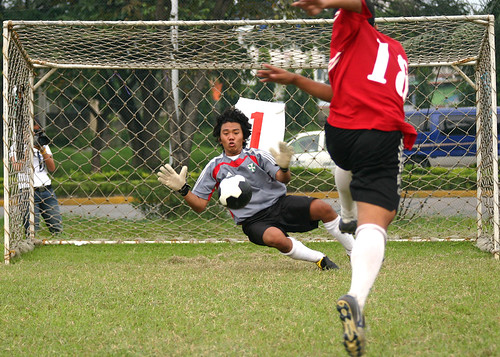
Football is popular in Cebu. This I learned the past 36 hours. When I entered the Cebu City Sports Center last Friday night, hundreds of pairs of spiked shoes and knee-high socks greeted my eyes. Yesterday morning, it was the same soccer-frenzy sight: girls kicking, boys sprinting towards the steel goal, coaches shouting, goalies jumping to stop a score…

The world’s No.1 sport is widespread and celebrated in the Philippines’ No.1 city. Take the 7th Thirsty Football Festival, a smorgasbord of 209 teams and 2,500 participants. All of them Cebuanos? No. Plenty arrived on our shores coming from Tubigon, Dumaguete, Tanjay, San Carlos, Iligan, Tacloban and Bacolod. Outside Manila, this event is possibly the largest gathering of footballers. My observations from the Thirsty Cup?

Football and music mix well. Who says you can’t play Boom-Boom Pow while the game is on? At the Thirsty event, hip-hop tunes scream loud from the loudspeakers. And what a fabulous idea. For today’s children are lovers of music; when their favorite songs are heard reverberating throughout the complex, it invigorates the players.

Football is best in the dark. Night games? Sure, why not. Thanks to the gleaming lights inside the Abellana grounds, darkness was transformed into daylight the past two evenings. Last Friday, the games extended until….. 11:30 p.m.

Too late for sports? Nah. As Steve Jobs proclaimed… “Think Different.” I say night games (possibly of any sport) is a superb plan. Minus the intense heat of the 12:30 p.m. sun, playing below the stars  means quicker running without squinting one’s eyes. This idea, I believe, was started in Cebu by the Thirsty event organizers: my brother Charlie, top organizer Neil Montesclaros, and the current president of the Don Bosco Alumni Football Club, Chad Songalia.

Quick Football. The concept of the “Football Festival” is unlike the World Cup games, for example, where 90 minutes are allotted per game. With this “festival,” it’s a brisk and spirited 15 minutes. After a short 7.5 minutes, the two squads change sides. This means that every second matters.

Bad? Well, yes, there’s nothing like the full game. Good? Well, yes, because more games are multiplied and everybody gets to play (especially our out-of-town visitors) in a short span of two days/two nights.

Football is for the family. I know plenty of dads who join the tournament. Their sons join, too. The grandfather of those sons watch the games. Lola brings the food and drinks. The other grandchildren come and cheer. So does the yaya. Plus the classmates. In football, everybody’s present.

Football is for the young. At the Thirsty Cup, the youngest category is the 6-years-and-under bracket. Yesterday, when I arrived at 10 a.m., I was fortunate to have met the finalists for this category. The champion team was the M. Lhuillier squad, composed mainly of children aged five and six years old. The runners-up? They were the San Roque Football Club who, upon a simple check, appeared much smaller. When I asked why, I found out that they had a three-year-old player and, unbelievably, one who was only two years old!

The MLDSF 6-and-under team with their coach (right) and Thirsty owner Bunny Pages

This, I’ve realized, is the superiority of soccer. Since it’s a team sport, one doesn’t have to possess advanced technical skills to join (unlike, for example, tennis or golf). If you can kick, you can join. That two-year-old, Marco Colina (the son of former top player Totot Colina), is the perfect example.

Football is for the once-young. Never mind if football is a highly physical (and injury-inducing) sport where, very often, elbows poke and kicks wallop and shoulders bump, one of the most popular categories is the 40-years-and-older division. The tournament’s oldest player? According to the records, there was one 61-year-old.

Isn’t this amazing? In the same soccer field of the same tournament, a two-year-old toddler kicks and runs like that 61-year-old grandfather.

Published
Categorized as Football

Photos

My brother Charlie Pages took these pictures during the 5th Thirsty Cup two years ago….

Published
Categorized as Football

Thirsty? This Football Festival quenches thirst

An article I wrote two years ago….

Football is the No.1 sport in my daughter’s school, Bright Academy. It’s no. 1 in Don Bosco. In CIS. In Springdale. In Sacred Heart School-Jesuit. Football is the No.1 sport in Asia. In South America. In Germany, Spain, England, France and even in a remote and tiny municipality in our own Panay Island called Barotac. And, in this round, celestial object floating in the universe called Earth, the no.1 sport is the same round, celestial object named soccer.

Take my daughter Jana. She’s the only child I have (so far), and she, of course, is a she—she’s a girl. And girls are NOT allowed to play football, right? There’s a law banning girls from kicking each other, right? And striking that ball with one’s head?

Ha-ha-ha, I know. Am I from another planet? you’d ask. But seriously, wasn’t football—during our time, when we were in school—exclusively for boys? While girls weren’t allowed to sweat and thus played nothing but takyan or “Chinese garter” or their perennial favorite, jackstones?

Yes. But that was then. That was decades ago. That was old school. Today, just like my daughter, football is the most-played sport for all those who wear skirts.

Which brings me to ask: Since most girls in elementary and in high school play football and, since it’s a given that a vast majority of boys play the same sport, then isn’t this game popularized by the Beckhams and Zidanes and Kakas the most popular sport in Cebu today, among students?

It is. Is it, you ask, more popular than basketball? The sport that’s absorbed us for decades ever since the eras of Magic and MJ and now, LBJ and Kobe?

It is. Football is tops. Want proof?

This weekend, visit the Cebu City Sports Center. Starting tomorrow at 5:30 p.m. until 11:30 p.m. on Sunday—that’s three full nights and two full days this weekend—the entire Abellana complex will wallop, kick, jolt, buzz and chant one word: F! O! O! T! B! A! L! L!

It’s called the 5th Thirsty Football Festival and—I must admit being biased in writing this—it’s an event organized by my family’s company and by my younger brother Charlie.

“When we started in 1994,” Charlie related to me, “we held it at the Ayala Center golf driving range. It was a huge success…. we had 90 teams joining.”

This year, I asked, how many are playing?

“228.”

Players?

“No, teams. Multiply that by an average of 10 players per team, that’s nearly 2,300 participants.”

Wow.

“Outside Manila, this should be the country’s biggest football event. And the good news is, we have a lot of out-of-town teams. Close to 200 teams come from Cebu and about 30 groups come from Manila, Bacolod, Dumaguete, Cagayan de Oro, Davao.

“Last year, we only had 140 teams but this year, it’s ballooned to a huge, huge number.”

Categories? Age brackets? I asked.

“Our youngest participants are six years old and below,” said Charlie.

Imagine girls and boys as young as 4, 5 or 6, kicking, tackling, scoring, guarding and raising their frail, little arms at the end for the win?

“Our oldest is the 40 and above category.”

Imagine fathers—and yes, possibly, grandfathers!—kicking, tackling, scoring, guarding and shoving each other for the big V?

Thanks to my brother Charlie (who was a basketball, not football, standout in school), to Neil Montesclaros (our indefatigable Tournament Director who was a former varsity star in Don Bosco and is now a Cebu Football Association director), and their team which includes Chad Songalia and Alex Lim, the 5th Thirsty Football Festival is what it is today: a giant festival.

Charlie with you-know-who

This weekend, if you visit, what will you see?

You’ll see six pitches (courts) scattered inside the giant grass field. You’ll see boys, girls, Men and Ladies competing in 14 divisions. You’ll hear music booming from the giant speakers. You’ll see parents screaming, referees blowing whistles, goalies blocking shots, strikers driving rifle-kicks, coaches losing voices.

Football… what a kick!

Published
Categorized as Football

Who doesn’t want to be as sexy as Angel Locsin?

Everybody except Simon Losiaboi or Posh Spice wants to lose weight. This is a fact. Like longing to be as voluptuous as Iza Calzado or pleading to stand beside (says my wife) Derek Ramsey, we all want to look trim, lean and svelte.

How to do it? Simple: Do sports. (Like running a marathon?) But the even simpler and more balanced formula: Eat less and sweat more. Lessen the calorie intake plus engage in badminton smashing or 28-lap swimming or dribbling full-court in basketball.

How else can we shed off extra poundage? Scouring through the internet late yesterday, I found Reader’s Digest (rd.com) and this eye-catching title: “Easy Ways To Lose Weight: 50+ Ideas.” To all wanting an Angel Locsin figure, here are (from that piece) a few of my favorite tips…

Hang a mirror opposite your seat at the table. One study found that eating in front of mirrors slashed the amount people ate by nearly one-third. Seems having to look yourself in the eye reflects back some of your own inner standards and goals, and reminds you of why you’re trying to lose weight in the first place.

Eat cereal for breakfast five days a week. Studies find that people who eat cereal for breakfast every day are significantly less likely to be obese and have diabetes than those who don’t.

Passionately kiss your partner 10 times a day. According to the 1991 Kinsey Institute New Report on Sex, a passionate kiss burns 6.4 calories per minute. Ten minutes a day of kissing equates to about 23,000 calories — or eight pounds — a year!

Brush your teeth after every meal, especially after dinner. That clean, minty freshness will serve as a cue to your body and brain that mealtime is over.

When you’re eating out with friends or family, dress up in your most flattering outfit. You’ll get loads of compliments, says Susie Galvez, author of Weight Loss Wisdom, which will be a great reminder to watch what you eat.

Spend 10 minutes a day walking up and down stairs. The Centers for Disease Control says that’s all it takes to help you shed as much as 10 pounds a year (assuming you don’t start eating more).

Switch to ordinary coffee. Fancy coffee drinks from trendy coffee joints often pack several hundred calories, thanks to whole milk, whipped cream, sugar, and sugary syrups.

Carry a palm-size notebook everywhere you go for one week. Write down every single morsel that enters your lips, even water. Studies have found that people who maintain food diaries wind up eating about 15 percent less food than those who don’t.

Eat slowly and calmly. Put your fork or spoon down between every bite. Sip water frequently. Your brain lags your stomach by about 20 minutes when it comes to satiety (fullness) signals. If you eat slowly enough, your brain will catch up to tell you that you are no longer in need of food.

Downsize your dinner plates. Studies find that the less food put in front of you, the less food you’ll eat.

Bring the color blue into your life more often. There’s a good reason you won’t see many fast-food restaurants decorated in blue: Believe it or not, the color blue functions as an appetite suppressant. So serve up dinner on blue plates, dress in blue while you eat, and cover your table with a blue tablecloth.

Don’t eat with a large group. A study published in the Journal of Physiological Behavior found that we tend to eat more when we eat with other people, most likely because we spend more time at the table.

Serve your dinner restaurant style (food on the plates) rather than family style (food served in bowls and on platters on the table). When your plate is empty, you’re finished; there’s no reaching for seconds.

Get up and walk around the office or your home for five minutes at least every two hours. Stuck at a desk all day? A brisk five-minute walk every two hours will parlay into an extra 20-minute walk by the end of the day.

Clean your closet of the “fat” clothes. Once you’ve reached your target weight, throw out or give away every piece of clothing that doesn’t fit.

Read more here.

19 points from the Australian Open

(Photos from australianopen.com)

After 14 Australian Open days of first serves that rocketed and half-volleys that dipped and slice backhands that skidded sharper than razor knives, here are 19 final thoughts….

1. Where was Jim Courier? I would have loved for him to have interviewed Roger Federer and Andy Murray during the Awards Presentation. Did you see his interview with Roger after the world no.1 beat Tsonga? That was the best I’ve ever seen. Him chatting with Murray and Federer at that awarding would have been a perfect ending.

2. Serena Williams? Amazing. Bandaged in the legs and looking bulky (well, she’s always looked more like a female NFL linebacker than an agile tennis player), she’s astonishing. Her secret? “My mental game is really strong,” she said. “My dad always said that tennis is 70 percent mental, and I believe that mentally I’m probably one of the toughest on the tour.” Still, her 12 majors is still far, far away from the record of 24 Grand Slam singles titles of Margaret Court of Australia.

3. Funny: When Serena and Venus Williams won the doubles crown, Venus didn’t know it. After winning that championship point, Venus thought they still had one game left to win. Can you believe that? She wasn’t paying attention to the score and, next thing she knew, they were Grand Slam champions!

4. I pitied Andy Murray during the awarding. And did his shedding a tear thwart Federer from doing the same when he spoke, as it appeared that the Swiss was teary-eyed prior to their speeches. Quote of the tournament, joked Murray: “I can cry like Roger; it’s a shame I can’t play like him.”

5. Federer has cried multiple times during these awarding ceremonies. Murray did. And Pete Sampras, during the Hall of Fame presentation in 2007, also poured his emotions. Isn’t this admirable to see, some of the world’s most high-profile and toughest of sportsmen, not afraid to cry?

6. Murray was too passive. Well, had he played his aggressive style when he clobbered Rafael Nadal and humbled Marin Cilic, he’d have stood a chance against Roger The Great. But Murray, in those first two sets, was tentative. He poorly floated the yellow ball in mid-court and was content with Roger dictating play. No way can you win against RF by being passive and hoping for him to make a slew of mistakes. Roger is Roger. He’s The Great. To beat him, you need to be aggressive and domineering. Never mind if you lose but that’s your only chance.

7.  The Oz Open was Murray’s 17th major event… the same 17 number when Federer won his first major title. But sorry, it wasn’t to be.

8. The 3rd set tiebreak? Wow. What a delight. Could the climax have been more thrilling than that? Five set points? Two missed championship points? At one point, after hitting a drop-shot, Roger let go of a scramble by Andy that he could have hit… imagine if he lost that set and, ultimately, the match? But no, Roger is Roger.

9. Too much Roger? We see his face up-close during the match and then, come TV commercial break, guess who’s face we see again in the Rolex ad?

10. Incredible stats: Once Federer wins the first set at a major, he’s 172-5. Up two sets, never mind: he’s 156-0.

11. That “156-0” record, doesn’t that remind us of Tiger Woods, who, once he’s leading in the final day, is unbeatable? Yes and no. Yes, he’s like the dominant Tiger; but, no, Fed fans protest, don’t compare him to Tiger!

12. Roger quote: “My game is not as taxing as other players’ games. I also think I have a very relaxed mind when it comes to the game of tennis.”

13. Ouch! To Rafa devotees, that’s painful. The reason: RN is out for four weeks due to the knee injury. Worse, he’s down to world no. 4 (first time since 2005), below Djokovic and Murray.

14. Blue overdose: the sky was blue, the outer court was blue, the inner rectangle was a different shade of blue, Roger wore the same color and so did Murray. Even the ballkids wore blue.

15. Justine Henin is bewildering. For a body so small (5’6”, 126 lbs.), she wallops her groundstrokes (that backhand!) as hard as anyone. Says Billie Jean King: “Pound for pound, Henin is the best tennis player of her generation.” An interesting fact: Henin was unranked and joining her first major in two years as a wild-card entry; she still needs to play one more event before she gets an official ranking.

16. Nothing like R & R. Watching last Sunday, I miss the duel between the lefty Spaniard and the Swiss right-hander. There’s still no contest like it. The reason? Mentally, Rafa “owns” Roger. Rafa’s forehand to Roger’s backhand? That was RF’s downfall. But an intriguing point: age 28, Roger has almost zero injuries versus the 23-year-old Rafa.

17. The day before the Open began, Roger organized a mixed-doubles fundraiser with Nadal, Andy Roddick, Kim Clijsters and Lleyton Hewitt. The match raised about $125,000.

18. Roger won 16 of his 22 trips to the Grand Slam finals. Of his six losses, one was to Del Potro and five were to Rafa.

19. Wrote Jon Wertheim in SI.com: “A year ago, Roger Federer had lost for the fourth time in five Slams and was reduced to tears by still another defeat at the hands of his rival, Rafael Nadal. Folks were well within their rights to wonder if he’d catch Pete Sampras’ record, if he were the greatest of all time after all. Since then? He’s won three of four majors — and probably should have won the fourth. With Nadal in iffy condition, with Federer’s mastery of the other contenders in majors, with his game back at such a high level, is it so far-fetched to speculate that this might be the year Federer wins all four majors?”

Published
Categorized as Tennis

Volleying? No one better than Jun San Juan

At the Casino Español de Cebu, if you conduct a survey among the tennis players and ask, “Who’s your top doubles player?” one name will surface among the top in the list. His name: Antonino San Juan, Jr., who first dribbled with basketball then spiked the volleyball before swinging at that tennis ball. Today, he’s a Class-A netter whose volleys up at the tennis net are skillful and precise.

The favorite word he memorizes? “Volley.” Because apart from using it often in this game of Justine Henin and Andy Murray, he also happens to be, just starting last month, Cebu’s highest-ranking official of the sport with the same first name: Volley.

Jun San Juan recently took over from Glenn Soco, who’s busy on the campaign trail as a Vice Governor candidate, the title of President of the Cebu Volleyball Association. “CEVA was started in the year 2000 by Glenn Soco,” answered Jun, in our exchange of emails. “I was one of the board of directors. In 2004, I rose to become the Vice President.” Today, Mr. San Juan heads one of the most dynamic of sporting bodies in Cebu. Thanks to him and Glenn and CEVA, their accomplishments the past 10 years have been exceptional.

“First, CEVA hosted two international events,” said Jun, when I asked for a list of their projects. “The World Men’s Volleyball and the Asia Youth Girls in 2004 participated in by 11 Asian nations, China, South Korea, Australia, Philippines, India, Thailand, Vietnam, Singapore, Malaysia, Indonesia, and Japan.” An even more popular project is the GUV Cup. Started in 2005, this partnership of CEVA and Gov. Gwen Garcia and the provincial government is now touted to be “the biggest and most prestigious volleyball tournament in the country with 47 participating municipalities and five component cities.” There’s more: The Nestea Beach Volley at Parkmall last year and the First Beach Volleyball in San Remegio, 2008-2009. The annual workshops and attestation of referees and coaches, said Jun, has also produced nine national referees from Cebu. Finally, through the GUV Cup, a national-caliber player was recognized: Jusabelle Brillo.

Yet, despite being the top honcho of CEVA, the interesting story is that Jun San Juan is not even the most famous volleyball personality in his family. His wife, Marichu Jao San Juan, is that person. “Chu” is one of the two Jao twins (together with Marilou Ramirez) who became national volleyball heroes during their athletic days. Cebu Hall of Fame? Yes, Marichu is a member of the exclusive club. The Milo National Little Olympics last October? Yes, it was Chu who lit the torch to spark the beginning of those games.

Jun and Chu

“I used to be a basketball player,” said Jun, when I asked how he started. “But when I saw the twins train and play in the national team in Manila, there was a change of heart and I immediately fell in love with volleyball.” Heart? Fell in love? I’m sure Jun was referring to Chu. After his shift from the orange basketball to the white volleyball in college, Jun became a member of the Mapua volleyball varsity team. Soon after, he was team captain for two years and, he says, “I was later drafted to play for the NCR selection in the Palarong Pambansa in Tuguegarao and was a candidate for the national team in 1981.”

As to CEVA’s plans for the year? They have plenty: 1) Beach Volleyball (Holy Week in Bantayan Island). 2) We will be conducting clinics by district level in the summer. 3) Coaches and Referees Seminar and Workshop at the Capitol Social Hall in August to be conducted by an international referee from Manila. 4) GUV Cup tournament from Sept. to Dec. 5) Planning stage on hosting a Beach Volleyball event in Parkmall. 6) Renovate the existing beach court in Parkmall & change the sand. 7) Planning stage on hosting an international tournament before the end of the year. With Jun and CEVA volleying, 2010 will be a smash.

Published
Categorized as Volleyball

Near-death tragedy turns into blessing for Z

“Gorres is okay,” said Michael Aldeguer, the president of ALA Promotions, when we spoke yesterday. “He just has a problem with the left side of his face. It’s not paralyzed but it’s not functioning normal yet. But you can talk to him. His mind is sharp and he communicates well. He remembers everything. He has no memory loss. He even makes jokes. But Z is still having a hard time walking. He can walk only for several meters. I talked to him five days ago and we were discussing when he’s coming home. He misses his kids a lot. I asked if he wanted to come home now and he said, ‘Sir, not yet. I don’t want my kids to see me like this.’”

The long-awaited return of our Cebuano hero? It’s late February or early March.

“Miracle,” added Michael. “It was a miracle. I was there all the time. It was one of the most severe cases they ever had, said the doctors. I couldn’t forget this because I slept at the hospital when all this happened. And you know that the doctors opened him up without delay. It was scary. It came to a point when the doctor told me, ‘We did what we had to do. But we’re not sure if he can make it.’ In fact, not many do make it. To me, I couldn’t imagine what would have happened.

“But something good is happening with the unfortunate case of Z. Because we met Frank Slaughter, who is a retired fighter and he’s with a nonprofit boxing organization. He’s talking to the Nevada authorities with the hope that a new state bill will raise the insurance amount of $50,000. That amount is too small.”

The total bill for Z? Just with the University Medical Center (UMC) hospital?

It’s 550,000. Pesos? I asked Mike. “Dollars,” he said. That’s $550,000 or over P26,000,000. “And that’s just for the UMC hospital. That excludes the expenses for the rehab in the U.S. and the rehab when Z’s back to Cebu which might take between six months to one year,” said Michael.

“Good thing plenty are helping. There’s Frank Slaughter, there’s Dr. Ben Calderon, Tony Martin and his wife, Yvonne, and so many more. A group from the U.S. has also launched a website that accepts donations for Z. This site is www.ZGorres.info. We will also soon, here in the Philippines, provide everyone with Z’s account number so donations can be sent straight to their family’s account.”

“Also, Manny Pacquiao has communicated with us and is looking at a mid-February target for a benefit dinner,” he said. “According to interviews, Manny hopes to raise $500,000 in that charity dinner for Z. That would be a great, great help. Right now, with the $550,000 amount, we’re working with Top Rank to pay that off… they have the means. We’re also talking with the insurance companies. We have to come up with something. What’s good is this incident has caused massive awareness, especially in Nevada, where they hold fights every week.”

Mr. Aldeguer then e-mailed me an article published in the state’s top newspaper, Las Vegas Review-Journal, with a full-length story on Z’s catastrophe and his problem with paying the medical bills.

“People have taken notice. The UMC Hospital CEO has spoken. Same with the Nevada State chairman. Boxing promoters make a lot of money and they have to ensure that boxers are well taken-cared of. Many people only see the good side of boxing… but it’s a brutal sport,” said Mike.

“This is our quest now. To help push for this bill. This will be good for the sport. This will be good for the boxers. Because what happened to Z will happen again.

“Even around Asia, where there are plenty of irresponsible fighters, there is awareness now after the scare with Z. Some fighters from Thailand or Indonesia get involved in mismatches. These are very scary. Now, some boxing commissions are getting stricter; they’re reviewing thoroughly the sanctioning of fights. They’re also ensuring that fighters are medically-prepared before they fight. This is the good that has come out of the bad. God has a purpose for Z.”

Visit ZGorres.info.

Before Pistol Pete and Federer Express, there was The Rocket

The year was 1999. That was 11 long years ago. Yet, when I look back at that singular moment–at those few precious seconds–when I got to shake the hand and pose for a photo with an all-time tennis great, the flashback rouses my face to smile.

It was the U.S. Open. Not your ordinary tournament, it was the rowdiest and largest Grand Slam event on this planet. My dad Bunny and I watched the full two weeks, each night and day absorbing an overload of forehands and backhands. On the first evening–on August 23, 1999–we trooped to the Louis Armstrong Stadium for the Opening Ceremony. We were energized. This was New York City. Then, minutes before the start, a small commotion startled the audience.

He entered. “He” happens to be the only player in mankind to have won all four Grand Slam titles (in Australia, France and the U.S., plus Wimbledon) in the same year… twice.

Wearing a green coat-and-tie with a red necklace strap hanging on his neck, his blonde hair was disheveled and his white cheeks glowed pink. Acting quickly, I climbed the steps then waited for that precise opening when I approached from the side, introduced myself as Filipino, then asked for that one-click-I’ll-never-forget-this moment as my dad snapped the photo.

No, he’s not Roger ‘Federer Express’ nor is he ‘Pistol Pete’ Sampras. He’s not Agassi or Becker or Borg or McEnroe. In fact, if you’ve followed tennis as I have–starting the 1980s–his name might not be all-too-famous. But if you know the game’s history, you know him. Even better, if you watch today’s Australian Open, then you’ve seen his name plastered on the TV screen.

Rodney George Laver. Nicknamed “The Rocket” because of his explosive style and named after his hometown of Rockhampton, Queensland, he’s the reason why that August ’99 moment I’ll always cherish. For Rod Laver stood–figuratively–tallest among the giants of the sport when, in fact, he’s only 5-foot-8 1/2 tall. In this era of Juan Martin del Potro (6’6”) and Ivo Karlovic (6’10”), he’s minuscule. Add to the equation his weight (145 lbs.) then you have a “pocket-sized” player. Yet, he’s a rocket. For, in his prime, he possessed a game as complete as Federer’s today.

“Few champions have been as devastating and dominant as Laver was as amateur and pro during the 1960s,” wrote Bud Collins. “An incessant attacker, he was nevertheless a complete player who glowed in backcourt ad at the net. Laver’s 5-foot-8 1/2, 145 pound body seemed to dangle from a massive left arm that belonged to a gorilla, an arm with which he bludgeoned the ball and was able to impart ferocious topspin. Although others had used topspin, Laver may have inspired a wave of heavy-hitting topspin practitioners of the 1970s such as Bjorn Bord and Guillermo Villas. The stroke became basic after Laver.”

Why this R. Laver piece today? Because when you click on Star Sports today, his name is forever etched in Melbourne. The reason? While Wimbledon, for example, has their famous “Centre Court,” the Oz Open’s main stadium is named after it’s greatest… the “Rod Laver Arena.”

For “Rod Laver” is the synonym of “Grand Slam,” which means winning the four majors in the same year. Take Federer: though he’s won all four majors, he did not achieve this feat in the same calendar year. Only four others have accomplished the real Grand Slam, and each achieved it only once: Don Budge (1938), Maureen Connolly Brinker (1953), Margaret Court (1970) and Steffi Graf (1988). The Rocket did this twice, in 1962 and 1969.

As the BBC commentator Dan Maskell put it, he was “technically faultless, from his richly varied serve to his feather-light touch on drop volleys plus a backhand drive carrying destructive topspin when needed or controlling slice when the situation demanded it.”

Sounds like Federer, right? Yes. But with a difference: Laver is left-handed. Which means he has the all-around, no-weaknesses armada of Roger plus the lefty serves and lefty topspin style of Rafael Nadal. Imagine morphing these two to form one? That’s Rod Laver.